
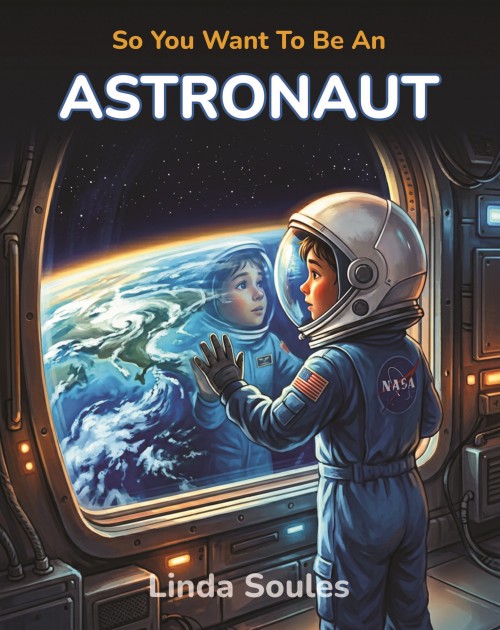


So You Want To Be An Astronaut
Every night, above the rooftops and streetlights, the same invitation hangs in the sky. Stars we've stared at for thousands of years. A moon we've walked on. Planets we've sent our machines to visit. And somewhere, right now, human beings are orbiting Earth at 17,500 miles per hour—living, working, and looking back down at the world the rest of us call home.
How does someone get there? How does someone become an astronaut?
In So You Want To Be An Astronaut, young readers ages 8–14 strap in for one of the most extraordinary journeys a book can offer: the journey into space. From launchpad to orbit, from spacewalks to splashdowns, this book opens up the real world of human spaceflight and the remarkable people who've dedicated their lives to reaching beyond our atmosphere.
Readers will meet the many kinds of astronauts shaping humanity's future among the stars: mission commanders piloting spacecraft, mission specialists running experiments aboard the International Space Station, flight engineers keeping everything running, scientist-astronauts studying everything from plants to black holes, and the new generation of commercial astronauts helping to open space to more people than ever before. They'll explore the tools of the trade—spacesuits, spacecraft, robotic arms, rovers, and the rigorous training that prepares an astronaut for the unexpected. And they'll learn the surprising truths of life in orbit: how astronauts sleep strapped to a wall, drink floating water, exercise two hours a day to keep their bones strong, and witness sixteen sunrises every single day.
Along the way, young readers come to know the qualities every astronaut shares: courage, teamwork, calm under pressure, scientific curiosity, physical and mental discipline, and a deep sense of purpose. They'll follow the real path from a child's first look through a telescope to years of study in science, engineering, medicine, or military aviation, and finally—for the lucky few—a seat on a rocket pointed at the sky.
Packed with astonishing facts, true stories of exploration, and the quiet awe of looking up, So You Want To Be An Astronaut is perfect for the kid who draws rockets in the margins of their homework, the one who memorizes the names of the planets, or the one who stands in the backyard at night and whispers, I want to go there someday.
Because becoming an astronaut isn't only about leaving Earth. It's about loving it enough to understand it from above.
Q. What inspired you to write this book? Was there a particular moment or event that sparked the idea?
Ans. Astronauts get talked about as if they're a separate species — heroes, daredevils, characters in a movie. But while researching this book, the number that stopped me cold was this: more than 600 people, from over 40 countries, have actually been to space. The youngest was 25. The oldest was 90. Real people. Many of whom were once just kids who refused to stop looking up. I wanted to write a book that treated astronaut as a real job — one with paperwork and plumbing repair and Russian-language requirements alongside the awe — because the child reading it might genuinely become the next person on that list. The dedication says it plainly: for every kid who ever looked up at the night sky and felt that they belonged out there. A lot of us were that kid.
Q. What research did you undertake to write this book? Were there any surprising or unexpected findings that you discovered during your research?
Ans. Deep, with a yellow legal pad — old habits die hard. NASA training documentation, astronaut memoirs (Scott Kelly's "Endurance" should be required reading), the literature on the Overview Effect, oral histories of the Soviet program. My family also made a trip to the Kennedy Space Center earlier this year, and I cannot recommend it enthusiastically enough. Standing under the Saturn V, which is roughly the length of a football field laid on its side, does something to your sense of scale that no book or documentary can replicate. The Atlantis exhibit in particular: the orbiter is suspended at an angle, payload bay doors open, as though caught mid-flight. The astronaut training simulators, the rocket garden, the firsthand accounts from former astronauts — every hour there sent me back to the manuscript with something I had to write in. But the finding that delighted me most, and that absolutely had to make it into the book: space has a fragrance. Astronauts coming back inside after a spacewalk consistently describe their suits as reeking of burned steak, gunpowder, and raspberries. Scientists believe it's chemistry from dying stars. I had been writing about space as a soundless, sterile vacuum. It turns out the universe itself has an aroma — and it's a barbecue and a fruit bowl simultaneously. You stop being able to hold the cosmos as an abstraction once you start really looking.
Q. What was the biggest challenge you faced while writing this book? How did you overcome it?
Ans. Tone. Specifically: how to write honestly about a job that involves both the most extraordinary view a human being has ever seen and also fixing toilets in zero gravity. Children's books about astronauts tend to err in two directions — glossy, breathless "reach for the stars!" inspiration with everything difficult sanded off, or the dutifully educational kind where you can feel the curriculum standards being checked in the margins. I wanted neither. The challenge was finding language that took the reader seriously enough to include the hard parts — the years between missions, the loneliness of six months away from family, the punishing physical recovery — without making the book feel discouraging. The way through, I think, was respect. Kids can absolutely hold the awe and the difficulty in the same hand. Adults often forget this. The book trusts them to do it.
Q. How did you go about developing the characters in the book? Were any of them based on real people or events?
Ans. Fair question, but I want to gently subvert it: this book has no fictional characters. The people in it are real — Yuri Gagarin landing in a Russian field after 108 minutes and meeting a startled woman with her granddaughter; Mae Jemison citing Lieutenant Uhura on Star Trek as the reason she believed she could go; Valentina Tereshkova, a twenty-six-year-old factory worker and amateur skydiver who applied to the cosmonaut program on a whim and became the first woman in space. Choosing whom to include was its own kind of character work. I wanted firsts, I wanted geographic and cultural breadth, and I wanted memorable specifics — the unexpected detail that lodges in a kid's head and refuses to leave. The other character I thought hardest about is the second-person you I'm addressing throughout. Who are those kids? What do they need to hear? That's the hardest character work there is, in any book where the reader is the protagonist.
Q. Can you share any interesting anecdotes or stories related to the writing of this book?
Ans. I was three drafts in and stuck on the launch sequence. I had written the countdown six different ways and they all felt manufactured. So I closed my laptop, pulled up a recording of the Apollo 11 launch, listened to it with my eyes shut, and discovered I had been holding my breath without noticing. That became the writing instruction for the section: write it the way it would be lived. Short sentences. Things shaking. The reader's chest pressed back into the seat. I trust writers who can be specific about a feeling more than writers who reach for big abstract words.
So You Want To Be an Astronaut pairs rigor with wonder for readers ten to twelve. Linda Soules writes as if she is beside a kid at the window: the dream is real, the work is hard, the sky st... Read the full review






Browse our calendar below to see all upcoming events and never miss a free book opportunity.
See Free Books & CalendarHelp us improve by giving your feedback.
Submit Feedback