
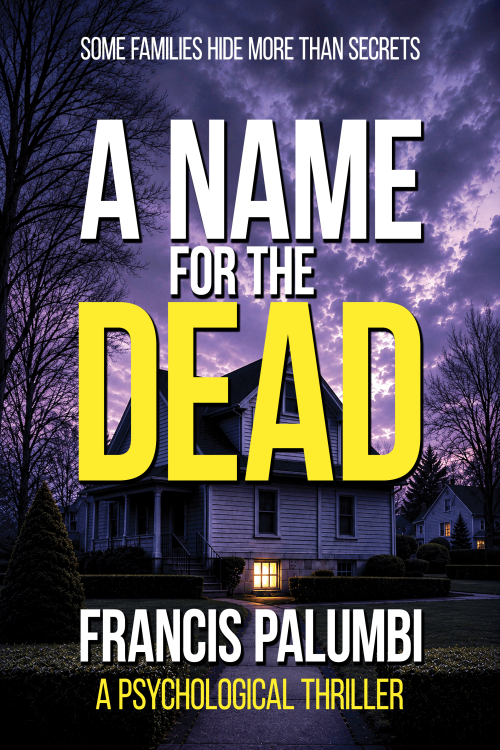


She accepted a job in a perfect house.
The little boy in her care was terrified of something downstairs.
And the door no one would talk about was always locked.
When Olena arrives in Connecticut to work as an au pair for the wealthy Whitaker family, she believes she’s found her chance to start over. The house is beautiful. The routine is flawless. The little boy in her care is quiet, watchful, and terrified of things no one will explain.
Then the noises begin.
Soft knocks behind the walls. Lights turning on when no one should be downstairs. Childlike drawings that feel more like warnings than innocent sketches. And a locked basement door no one in the house will talk about.
The longer Olena stays, the more she realizes something is terribly wrong inside the Whitakers’ carefully controlled world. Milo knows more than he says. His mother sees everything. His father prefers not to ask questions. And buried beneath the silence of that house is a secret someone has already decided must stay hidden—no matter the cost.
A Name for the Dead is a gripping psychological thriller about family lies, buried identities, manipulation, and the dark things people do in the name of protection. Tense, unsettling, and impossible to put down, it’s perfect for readers who love domestic suspense, slow-burning dread, and shocking emotional twists.
If you love dark psychological thrillers, hidden secrets, disturbing family dynamics, and page-turning suspense, this novel will keep you reading late into the night.
Q. What inspired you to write this book? Was there a particular moment or event that sparked the idea?
Ans. What inspired me was something very personal: my partner’s story. She is Ukrainian, and for many years one of her dreams was to visit the United States. When she was younger, she actually tried to obtain a visa through an au pair agency. That detail stayed with me — the idea of a young woman leaving Ukraine, entering another family’s home in a foreign country, and finding herself inside a world she doesn’t fully understand. From there, the story slowly began to take shape. At first, it wasn’t a thriller. It was simply the image of a young Ukrainian woman arriving in America with hope, uncertainty, and a need to build a different future for herself. But then I started asking myself darker questions: What if the family she joined was hiding something? What if the house looked perfect from the outside, but inside there was a secret no one was allowed to name? That was the beginning of A Name for the Dead. It grew from a real emotional starting point — the dream of America, migration, trust, vulnerability — and gradually became a psychological thriller about identity, silence, and the truths families try to bury.
Q. What research did you undertake to write this book? Were there any surprising or unexpected findings that you discovered during your research?
Ans. The research for this book was a mix of practical, emotional, and procedural research. I started with the world closest to the heart of the story: Ukraine, migration, and the au pair process. Since the initial inspiration came from my partner’s experience — her dream of visiting the United States and her attempt, when she was younger, to apply through an au pair agency — I wanted the beginning of Olena’s journey to feel grounded and believable. I researched how those programs work, what kind of interviews and documents are involved, and what it might feel like for a young woman from Ukraine to enter an American family’s home not as a guest, but as someone dependent on that family for housing, work, and security. Then I focused on the domestic thriller elements: how control can exist inside a seemingly normal household, how silence can become part of a family system, and how a child might process trauma without fully understanding it. One of the most important aspects for me was avoiding a simple “monster in the house” story. I wanted the Whitakers to feel socially believable — the kind of family that could appear respectable from the outside while hiding something deeply disturbing inside. I also researched legal and procedural details: child welfare involvement, police investigations, old records, death certificates, medical documentation, custody issues, and how past events can resurface through paperwork. That part surprised me more than I expected. I became very interested in how identity can be shaped, hidden, or distorted by documents. A name on a form can seem official, but the truth behind it may be much more fragile. The most unexpected discovery was probably how much of the horror in the story did not need to come from violence itself, but from bureaucracy, omission, and delay. A locked door is frightening, of course — but a false document, a missing record, or an adult who chooses not to ask the right question can be just as terrifying. That became one of the central ideas of A Name for the Dead: sometimes the most dangerous secrets are not hidden in darkness, but in plain sight, protected by silence, routine, and paperwork.
Q. What was the biggest challenge you faced while writing this book? How did you overcome it?
Ans. The biggest challenge was finding the time to write. I have a job, a family, and two daughters, so my days are almost completely full. Writing a novel required a kind of discipline I had never truly tested before. It wasn’t something I could do when everything else was finished, because everything else was never really finished. But I deeply wanted to write this book. It was not just an idea I liked — it was a story I felt I needed to complete. So I wrote at night and on weekends, whenever I could find the space. Sometimes that meant writing when I was tired, or when I only had a small window of time. I kept going for months, scene by scene, chapter by chapter, until the manuscript was finished. That process taught me that writing a book is not only about inspiration. It is also about persistence. You have to keep returning to the story, even when life is busy, even when progress feels slow. Eventually, that commitment brought me to the finish line, and A Name for the Dead was published in March 2026.
Q. How did you go about developing the characters in the book? Were any of them based on real people or events?
Ans. The characters developed from a combination of personal inspiration and imagination. Olena was inspired, in part, by my partner, Tatiana. She is Ukrainian, and some of the emotional foundation of Olena’s journey comes from her story: the dream of visiting the United States, the idea of leaving Ukraine as a young woman, and the vulnerability of entering another country through an au pair program. Olena is not a direct portrait of Tatiana, but Tatiana’s experience gave me the emotional starting point for the character. Sergey was also inspired by a real person: a close friend of Tatiana’s in Ukraine. I liked the idea of someone from Olena’s past remaining connected to her, even from far away — someone practical, loyal, and able to help her when the truth becomes too dangerous to face alone. The other characters, however, are fictional. The Whitakers, Milo, Eleanor, Reyes, Levin — they came from my imagination and from my interest in psychological thrillers and domestic suspense. I have always been drawn to stories about families that look normal from the outside but hide something deeply disturbing underneath. That kind of contrast — respectability and darkness, routine and fear, silence and truth — was central to how I built the characters. I didn’t want the villains to feel like caricatures. I wanted them to feel believable: people who justify themselves, control the narrative, and hide behind ordinary roles like parent, doctor, neighbor, or professional. At the same time, I wanted Olena to feel human rather than heroic — someone frightened, uncertain, and imperfect, but capable of courage when it matters. So while the emotional seed of the book came from real life, the story itself is fiction. It grew out of personal experience, imagination, and my love for the kind of thriller where the most frightening thing is not a stranger in the dark, but the family behind a closed door.







Browse our calendar below to see all upcoming events and never miss a free book opportunity.
See Free Books & CalendarHelp us improve by giving your feedback.
Submit Feedback