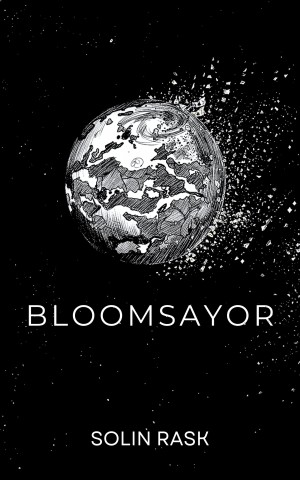

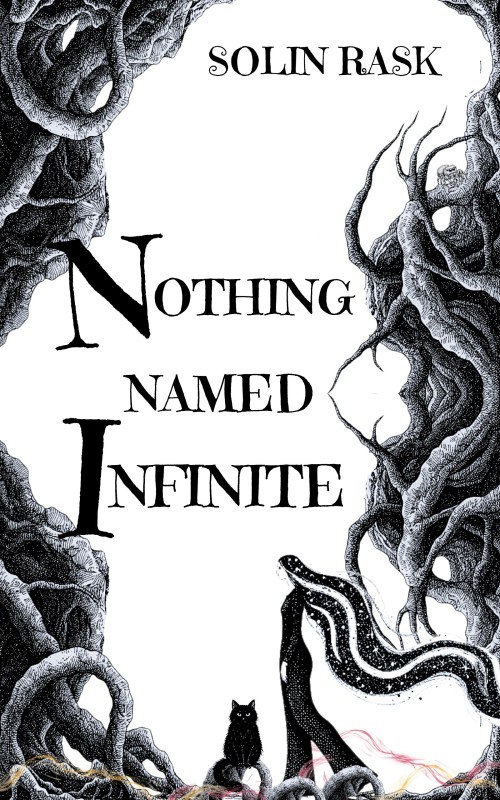


Coni's half-heart used to be the strangest thing about her. Now it could be the photons coursing through her veins; her talking cat, Void; the threads of light she can travel on; or the fact that she has begun, quite literally, to Disappear.
Coni's freckles vanish first. Then her hair, then the organs she can spare. She has two kidneys, after all. She would be facing all of it alone if not for Void and Nergui, the woman who followed a golden thread across the world to find her. But they can’t make Coni whole again.
When Coni’s mouth Disappears, the choice she must make becomes simple and impossible: leave with Void to claim a new name and abandon everyone she loves, or stay and Disappear completely.
Claiming the name saves her, but it also strands her and Void in a sentient library drifting through space, which would feel stranger if anything in her life still qualified as normal. There, she learns that Disappearing has another name: the Scourge, and it's been erasing whole regions of the universe for millennia. A thousand Possibilities once existed to stop it; only three remain. Coni's good at math; she knows exactly how bad those odds are. She wasn't the first to Disappear on Earth, but unless she can turn a Possibility into a certainty, she won't be the last.
Q. What research did you undertake to write this book? Were there any surprising or unexpected findings that you discovered during your research?
Ans. I did a ton of reading about quantum entanglement, astrophysics, astrobiology, and concepts like the Einstein-Rosen bridge and Information Theory. There are many fantastical elements in these books, but I wanted science to serve as the grounding for the Interion universe and every story in it. Take the Hemaliths, whom Coni first hears about when she and Void thread to the Archive of Nothing. I wanted beings who had adapted to a low-gravity world that is tidally locked to its star, so one face lies in perpetual day, the other in perpetual night, with a band of permanent twilight between them. That twilight band, the terminator zone, is the only place life could comfortably take hold, and that single constraint let me reason out the rest. Low gravity loosens the limits on body size and shape, and the dim, reddish light of a world circling a cool red dwarf would push their biology toward large, light-gathering eyes and a metabolism built to make the most of very little light.
Q. What was the biggest challenge you faced while writing this book? How did you overcome it?
Ans. My darling dog, Nala, died unexpectedly while I was writing this book. I had been in such a good writing rhythm, and after she passed, I stopped writing for months. My cat had died unexpectedly the year before, and the two losses compounded each other. The only way I got through was going into nature and crying, and crying, and crying, and just living through it. That's all you can really do with grief. When I finally returned to writing, I was living in Japan. The morning I began the Long Morrow chapter, I'd gone to Nara Park as I always did, and for the first time, I noticed a few cats who lived in a house right on the edge of the park. They came up to me, and I spent the morning with them and with the gentle deer Nara is known for. Cats have always had a way of telling me I'm on the right path, and the deer were their own kind of sign. Nala went wild for deer every time we caught sight of them in the woods (she was, as I like to say, a velociraptor in a husky's body). Sitting there among the cats and the deer, I felt like it was time to tell Coni and Void’s story again.











Browse our calendar below to see all upcoming events and never miss a free book opportunity.
See Free Books & CalendarHelp us improve by giving your feedback.
Submit Feedback