
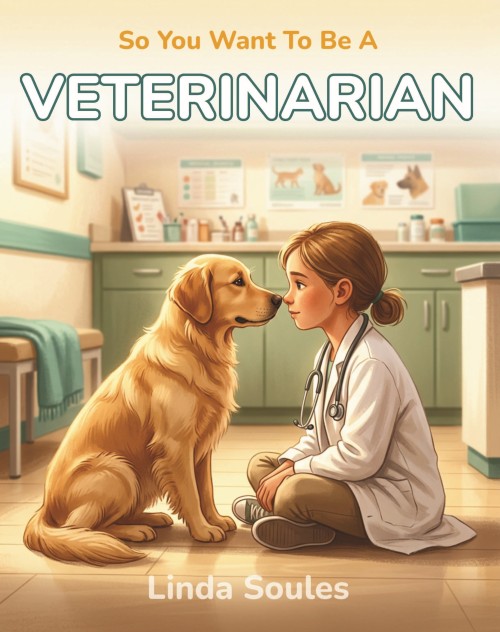


What if the patient you're trying to save can't tell you a single thing about what's wrong? Welcome to the world of veterinary medicine — where science, instinct, and compassion collide every single day.
So You Want To Be A Veterinarian is an illustrated guide for kids ages 10 to 14 who feel drawn to animals and want to know what it really means to build a career caring for them. Not someday. Not in the abstract. Right now, in concrete detail that respects how seriously young people think about their futures.
You'll follow veterinarians through real days — diagnosing a family pet with a puzzling illness, performing surgery that demands precision across unfamiliar anatomy, making split-second decisions in emergencies where every minute counts. You'll learn the science behind how vets read what animals cannot say, interpreting symptoms through physical exams, diagnostic imaging, and lab work that would challenge any medical professional.
But this book goes further than the exam room. You'll explore the extraordinary range of veterinary careers most people never hear about. Some vets care for pets in neighborhood clinics. Others work with horses, livestock, or zoo animals. Some protect wildlife populations in the field. Others shape public health policy or lead research that keeps both animals and humans safe. The field is wider, more surprising, and more needed than most kids — or adults — ever realize.
You'll also get the honest truth about what this path demands. The years of studying biology, chemistry, and animal science before you ever touch a patient. The emotional courage it takes to face outcomes you can't fix. The physical stamina required to work with animals that are scared, hurting, and sometimes ten times your size. And alongside all of that — the powerful sense of purpose that makes veterinarians say they wouldn't trade this work for anything.
Whether you're the kid who kneels down beside every animal you meet, the one who reads everything about wildlife, or the young person quietly wondering if a career in veterinary medicine might be your calling, this book brings you all the way inside the profession. It's educational nonfiction that doesn't talk down — it trusts you with the real answers.
The next patient is waiting. It can't speak. But you're already learning its language.
Q. What inspired you to write this book? Was there a particular moment or event that sparked the idea?
Ans. The dedication says most of it: For every kid who ever whispered to a scared animal "it's going to be okay." I was that kid. I grew up with cats, and I have been an animal person my whole life — the kind of child who notices when the cat's tail is held just slightly differently today than yesterday. What sparked the book specifically was realizing that veterinary medicine is the only branch of medicine where the patient can never tell you what's wrong. A human can say, "It's been hurting for three days, and it's a dull ache, not a sharp one." A vet's patient can only show you. That asymmetry struck me as quietly heroic — an entire profession built on the discipline of paying attention, on reading what cannot be told. Every kid who has ever sat very still next to a frightened animal already knows the first thing a vet has to learn. I wanted to write the book that says to that child: yes, this counts. This is the start of something.
Q. What research did you undertake to write this book? Were there any surprising or unexpected findings that you discovered during your research?
Ans. A great deal of reading — James Herriot first, because everyone who writes about vets owes him a debt, alongside current veterinary journals, AVMA materials, oral histories, and mental-health research on the profession. But the most important research was conversational. I talked with practicing veterinarians and veterinary technicians, because the texture of this work — what the day actually feels like, what the room feels like during a hard conversation, what makes them laugh in the break room — lives in the people doing it, not in the textbooks. The technicians in particular were a revelation. They often know the patients best. They are the ones who can tell you that this particular Labrador is terrified of the scale but fine with the exam table, or that this cat will let you do anything as long as you keep one hand on her shoulder. The most surprising historical find was Aleen Cust, who did the work of a veterinarian in rural Ireland for over twenty years before the Royal College of Veterinary Surgeons would let her sit the qualifying exam, in 1922, because she was a woman. She had been a vet for two decades by the time she was officially allowed to be one. The other surprise was the data on mental-health burden in the profession — a quiet weight that the field has only recently begun to discuss openly, and that nobody had really named for me before I started asking.
Q. What was the biggest challenge you faced while writing this book? How did you overcome it?
Ans. Holding the joy and the grief in the same hand. Vet medicine is truly one of the funniest jobs on earth — parrots who scream "HELP! HELP!" during routine checkups, hamsters who lead the staff on ten-minute chases through the clinic, lizards with sunburns, dogs who have eaten an entire birthday cake including the candles. And it is also a profession in which euthanasia is a routine clinical tool and the emotional toll on practitioners is heartbreakingly real. A children's book on this subject can fail in two opposite directions: sentimentalize the work into puppies and rainbows, or frighten thoughtful kids away from a calling that desperately needs them. What helped me find the line was the vets and techs with whom I spoke. Every one of them, without exception, described the work the same way: it is the hardest thing they have ever done, and they would do nothing else. Once I heard that often enough, I trusted I could let the funny chapter sit right next to the hard one. Kids can hold complicated truths. They do it every day.
Q. How did you go about developing the characters in the book? Were any of them based on real people or events?
Ans. The book is nonfiction, so the "characters" are really archetypes — composites drawn from real veterinarians and the technicians and assistants who work alongside them. The country vet at three in the morning, the small-animal practitioner who has known a family across a dog's entire life, the wildlife vet on the beach with the stranded sea turtle. Three real figures anchor the book: James Herriot, who taught the world that a country vet's life is one of the most fully human lives imaginable; Aleen Cust, who simply refused to wait for permission; and Temple Grandin, who is not a veterinarian but has shaped veterinary thinking by insisting that animals perceive the world differently than we do, and that the difference is the entire point. And then there is the unnamed child in the dedication — the one who whispered gently to a scared animal. That child is the real protagonist of every book in this series. The famous people are the scaffolding. That kid is the heart.
Q. Can you share any interesting anecdotes or stories related to the writing of this book?
Ans. Two stay with me. The first came from a veterinary technician — the cat who got its head stuck in a tissue box at home and walked into the clinic still wearing it like a helmet. It made me laugh out loud at my desk, and it made it into the book; some details are too good to lose. The second is a fact I almost couldn't believe when I first came across it. Secretariat's heart, when finally measured, weighed about twenty-two pounds — more than twice the size of an ordinary horse's heart. Some scientists believe that single anatomical detail is part of why he ran the way he did. I kept turning that one over while I wrote. A profession built on understanding bodies most of us never see, and a champion whose secret was hiding in plain sight inside his chest. There is a metaphor in there for the whole field, I think. And anyone who has lived with cats knows a smaller version of the same truth; the quiet animal in your lap is doing far more, and feeling far more, than the surface ever lets on. The vets and techs I know have spent their lives learning to see it. The book is, in a way, an invitation for the next generation of kids to start learning to see it too.

So You Want To Be A Veterinarian, Linda Soules's entry in the So You Want To Be A... series, centers on a challenge no human doctor faces: your patient cannot say its ear has hurt for three... Read the full review






Browse our calendar below to see all upcoming events and never miss a free book opportunity.
See Free Books & CalendarHelp us improve by giving your feedback.
Submit Feedback