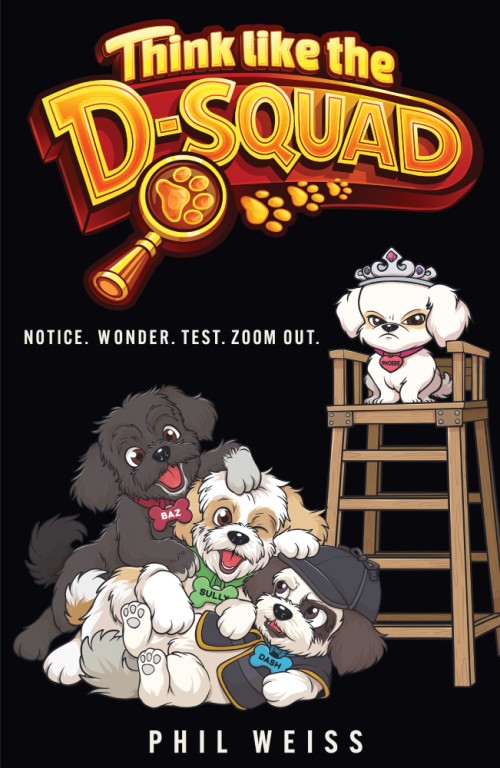

Is this read good? Sully stopped showing us his finds. Baz blames a raccoon. Dash wants proof. Phoebe already knows.
Don't let the page count fool you. Big type, generous spacing, and short chapters make this a fast, easy read. Nearly a quarter of the book is support material for teachers and homeschoolers, all tucked in the back: a glossary, discussion questions, a fill-in case file, sources, and standards alignment. It's no textbook.
Think Like the D-Squad follows four real dogs and turns the way they think into a toolkit kids can use. Dash narrates. Sully notices what everybody else walks past. Baz wonders out loud, ten wild ideas at a time, most of them wrong, which is the point. Dash tests hunches instead of arguing. Phoebe asks the question nobody thought to ask.
Notice. Wonder. Test. Zoom Out.
Across eighteen funny chapters and a final chapter that brings all four moves together, kids ages 8 to 12 learn how to spot the real problem, generate ideas without filtering too soon, check what they think they know, change their minds when the evidence changes, disagree without fighting, and recognize when a better answer begins with a different question.
An ongoing mystery about Sully runs through the book. Optional science boxes connect the chapters to real research, from the invisible gorilla experiment to forecasters who improve by changing their minds when the evidence changes. Each chapter includes a short dare to try the skill. The back of the book adds a glossary, discussion questions, a fill-in case file, sources, and standards alignment for classrooms and homeschools.
Author Phil Weiss was failing three of his four major eighth-grade subjects while playing sanctioned backgammon tournaments against adults. Diagnosed as autistic later in life, he wrote Think Like the D-Squad for every kind of thinker: the kid who struggles, the kid who races ahead, and everyone in between.











Browse our calendar below to see all upcoming events and never miss a free book opportunity.
See Free Books & CalendarHelp us improve by giving your feedback.
Submit Feedback