Home / Book Reviews / Cognitive Kin
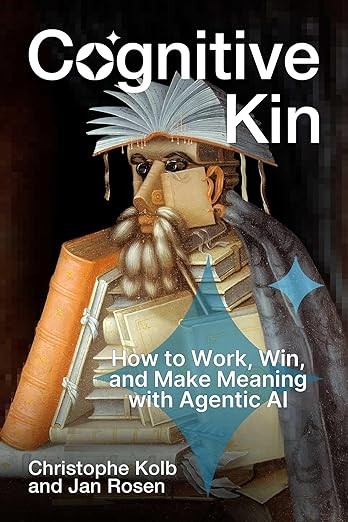
Cognitive Kin is the kind of book I wish had existed two years ago. It cuts through the AI hype and doom with a single, steady idea: the future isn’t tools versus humans—it’s kinship. Kolb and Rosen don’t shout; they guide, and that tone alone is a relief.
What they’re really doing is walking you through a world that’s already forming. They start with the moment machines stopped waiting for permission—the shift from autocomplete to full autonomy—and then follow that thread everywhere it goes: into digital labor, the “post-firm,” leadership, culture, and finally into questions of consciousness and identity. It’s not a manifesto; it’s a long, careful look at how agentic AI is rewiring work, organizations, and what we mean by “us.” You get the sense they’ve been in the room where these systems are built and governed, and they’re sharing what they’ve seen. Algorithmic realtors, voice agents at the drive-thru, insurance claims that clear in days—I kept underlining those bits; the abstract suddenly had texture. Wittgenstein, Borges, Lovelace, Nietzsche turn up again and again, and they’re actually in the argument, not name-dropped. That keeps the tone human when it could easily slide into grandstanding.
The writing is clear and often vivid (Borges’s infinite library, the dance floor where the lead changes hands), though eighty chapters across twenty parts can feel dense. Leader’s Playbooks help, but the payoff is for readers willing to sit with the argument. The book stays thoughtful and grounded, and avoids both utopianism and panic.
We’re already evolving in lockstep with another kind of mind, and the real job is to steer that, not run from it. I closed it thinking that if you lead, build, or just worry about where things are headed, you should read it.
“ There are worse crimes than burning books. One of them is not reading them. ” ― Joseph Brodsky

Help us improve by giving your feedback.
Submit Feedback